What is a Force Majeure Clause?
Suppose you purchased an off-plan apartment and the developer halts construction at the third floor, claiming "costs went up." To protect your investment, you must understand the limits of the Force Majeure clause in your contract.
Suppose you purchased an off-plan apartment and the developer halts construction at the third floor, claiming "costs went up." To protect your investment, you must understand the limits of the Force Majeure clause in your contract.
The Definition
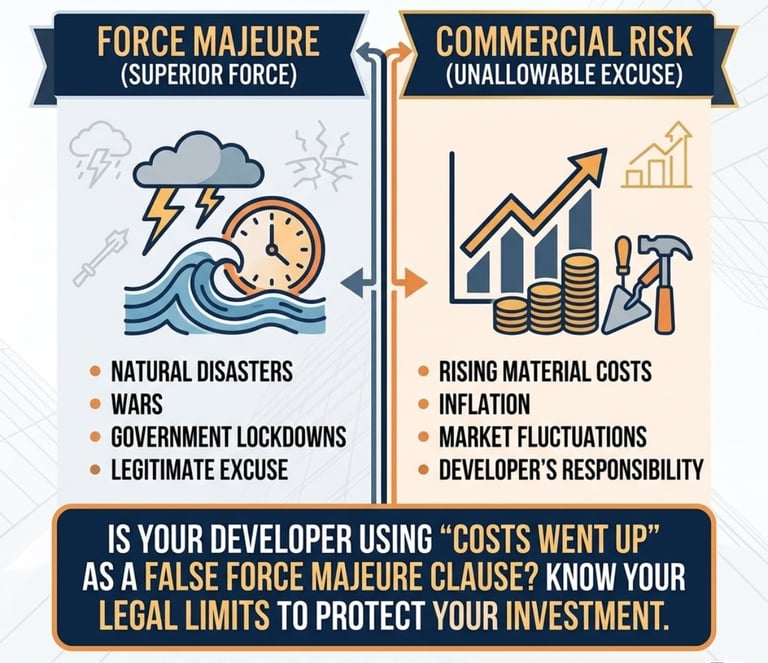
Derived from French, Force Majeure literally means “superior force.” In legal terms, it refers to extraordinary, unforeseeable events—such as natural disasters, wars, or government-mandated lockdowns—that make it fundamentally impossible for a party to fulfill their contractual obligations.
The Developer’s Tactics
In an off-plan Contract of Sale (COS), you will find a Force Majeure clause stating that if such "uncontrollable events" occur, the developer is excused from liability for delays.
The danger arises when developers attempt to classify inflation, rising material costs, or supply shortages as Force Majeure. While they may successfully use this argument to pressure unrepresented investors into paying more, the legal reality is different:
1. Business Risk vs. Superior Force: Courts generally treat market fluctuations and inflation as ordinary commercial risks, not valid grounds for Force Majeure.
2. The Strategic Shift: When a developer realizes an investor has professional advisory backing, they often drop the Force Majeure excuse.
What happens when the developer knows you are legally protected?
The focus shifts from "uncontrollable events" to the technical specifics of your Variation Clause. We will explore this shift in my next article.
Mary Edet
Private Real Estate Advisor, Edet Real Estate
© 2026. All rights reserved.
Member of the Billionaires Realtors Group (BRG)